'Thou shalt not make unto thee any graven image' - 2nd Commandment
Although Jesus in the New Testament has no physical description, Christians have always been creative when it comes to drawing how they imagine God to be through various images, artwork, statues and idols.The table below details the development of Jesus' face over 6-stages in the first 400 years of Christianity.

Stage 1 of 6
It is clear from scriptural and historical evidence that the early Church had no images of Jesus.
The early Church had always been strict in forbidding the adoration of images and therefore did not want Jesus' face to be memorable Claudine Chavannes-Mazel. Popular Belief and the Image of the Beardless Christ, Visual Resources, Vol.19, No.1, p.29
Stage 2 of 6
Early Jewish-Christians faithfully observed the 10 Commandments, and applied the Second Commandment to Jesus. For some Jewish-Christians, Jesus was God, and therefore it was forbidden to illustrate him.
[In first century] Idol worship was interwoven with life in every department. Images stood in every house to receive adoration; libations were poured out to the gods at every festival; with every civic or provincial ceremony the images were worshiped. In such forms the [early] Christians would take no part. Jesse Lyman Hurlbut, Historian. The Story of the Christian Church, 1970, p.41

Stage 3 of 6
Images of Jesus began to appear around 240-256 AD. Artists who lived over 200 years after Jesus, had never met him or his disciples, began to draw Jesus for the first time ever.
The earliest images of Jesus portray him as a 'Good Shepherd' holding a lamb. He is a young, physically fit, beardless man.
Why was Jesus portrayed as a Shepherd?
Plagarizing images from Graeco-Roman pagan art was a common theme and a popular way of associating familiar Christian icons with previous historical, and often mythical personalities.Unsurprisingly, Jesus the shepherd images were discovered in the catacombs in Rome, and not in Judea or Asia Minor, where the majority of early Jewish-Christians lived.
The early images of Jesus borrow from Greco-Roman pagan art where a shepherd image was visioned as a symbol of philanthropy André Grabar, Origins of Christian Iconography, pp. 218-219

Stage 4 of 6
After Emperor Constantine's conversion to Christianity in 325 AD, more detailed artistic representations of Jesus began to be appear in churches. Jesus was modelled on Rome's vision of a 'great God'.
Though there continued to be resistance, the use of icons and images won out and became entrenched in the Christianity that originated from Rome and Byzantium. Early artwork retained an artistic links with historical pagan images and traditions.
The Greco-Roman customs of worshipping deities through statues and images had became central to Christianity. The earlier Jewish-Christian values of refraining from depicting God, and observing the Jewish 2nd Commandment had failed.
Emperor Constantine converts to Christianity
After Constantine converted, the religion of Christianity changed forever. Most historians acknowledge the influence of various pagan gods and dieties on the early images of Jesus.After the conversion of Constantine all the barriers [to the use of images] were broken down Paul Johnson. Historian. A History of Christianity, pp. 102-103
The representation of Christ as the Almighty Lord on his judgement throne owed something to pictures of Zeus Henry Chadwick, The Penguin History of the Early Church, 1967, p. 283
Jesus' representation as a version of Apollo or Helios in the Vatican necropolis demonstrates the way the Roman gods were directly challenged; Jesus usurps their place, often with iconographic attributes that make him quite similar in appearance to various pagan deities Robin Jensen, Understanding Early Christian Art, 2000, p. 120
When Christ is given a youthful, beardless face and loose, long locks it assimilates him into the company of Apollo and Dionysus. Insofar as he copied the look of Apollo or Dionysus, he assumed something of their feminine aspect as well Thomas Mathews, The Clash of Gods, 1993, pp. 126-128
The clean-shaven visage more resembles the representations of Apollo or the youthful Dionysus, Mithras, and such semi-divines or human heroes as Orpheus, Meleager, and even Hercules. A youthful appearance recalls the divine attributes most associated with personal savior gods Robin Jensen, Understanding Early Christian Art, 2000, p. 119
Stage 5 of 6
To glorify the wisdom and power of Jesus as 'Heavenly Judge', artists turned for inspiration to the more powerful and authoritative gods in the Roman pantheon, such as the Roman version of Zeus, Jupiter, Neptune and Serapis.
Rome and Byzantium adopted the Christian faith and began the 'systemic' introduction of icons, saints, images, idols and statues across all aspects of Christianity, Churches and religious architecture.
Why did Jesus have a beard?
Gods in the Roman pantheon often had long hair and beards, to distinguish them from mortals and symbolize their wisdom and authority.A full-bearded face suggests authority, majesty, and power and may be seen in the portraits of the senior male deities of the Roman pantheon - Jupiter and Neptune, or even the Egyptian import, Serapis. The mature and bearded figure perhaps emphasizes Jesus' sovereignty over the cosmos. Here Christ takes Jupiter's place in the pagan pantheon, and the iconography makes that displacement explicit Jensen, pp. 119-120
Why did Jesus have long hair?
Jesus was drawn with long hair as the male gods of the Greco-Roman pantheon almost always were depicted with long hair.In Greek and Roman art loose, long hair was a mark of divinity. In letting his hair down Christ took on an aura of divinity that set him apart from the disciples and onlookers who are represented with him Thomas Mathews, The Clash of Gods, 1993, pp. 126-127
Towards the end of the fourth century, the use of images in the churches became general. People began to prostrate themselves before them, and many of the more ignorant to worship them. The defenders of this practice said that they were merely showing their reverence for the precious symbols of an absent Lord and his saints George Fisher, History of the Christian Church, 1915, p. 117
It was only after Constantine, about the time of Damasus (305-384 AD), that the picture of Jesus was changed from the youthful wonder-worker to the royal or majestic Lord. At that time, Jesus shifted more to a bearded, elderly, dominant figure Graydon F. Snyder, Ante Pacem: Archaeological Evidence of Church Life Before Constantine, p. 298
Stage 6 of 6
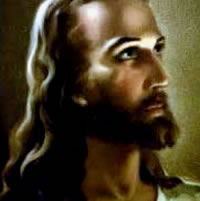
Images of Jesus are everywhere and found in churches, catacombs and even on robes worn by priests. The images continue as 'best attempts' by artists who base their creativity on preconceived ideas and notions.
What is the image of Jesus today?
Today, Jesus art depicts him as a youthful, physically fit, somewhat effeminate, long-haired man. But the actual image depends on which country and ethnicity you belong to. The image of Jesus 'the Man-God' has been customized to respect the local customs and culture of the Christian community.To view images of Jesus from across the world, click here Jesus - God with 99 Faces
Islam forbids the drawing of Jesus, or any other Prophet
Islam strictly forbids drawing images or illustrations of any Prophet of God. As it involves detracting from their status and showing disrespect to them. It is a transgression against their dignity and undermines the Prophets as the best of God's creation.| 18838 views · 7 hrs ago | Author: Guest • Updated: 01 Oct 2019 |
ALL ARTICLES ARE INTENDED FOR GENERAL EDUCATIONAL PURPOSES ONLY. ALL INFORMATION IS BELIEVED TO BE CORRECT, ACCURATE AND TRUTHFUL. YOU ARE ADVISED TO DO YOUR OWN RESEARCH. ARTICLES ARE LIVE DOCUMENTS AND MAY BE UPDATED WITH NEW CONTENT AT ANY TIME. WHERE AVAILABLE, SOURCES AND REFERENCES ARE CREDITED. IF YOU SPOT ANY ERRORS, OMISSIONS OR GIVE FEEDBACK KINDLY CONTACT US WITH DETAILS
169-jesus-no-face