Gospel authorship is often debated amongst Bible scholars
Even today, all of the Gospel authors remain 'Anonymous'. It is unclear who authored the Gospels and multiple theories simply add to the confusion on this central doctrinal issue.
It is striking to see the underlying modern historicist assumption just taken for granted, that these [Gospel] authors all wrote in an entirely human fashion. There is no mention of divine inspiration anywhere
Dungan, History of the Synoptic Problem p.322
Dungan, History of the Synoptic Problem p.322
| Mark | Matthew | Luke | John | ||||||||||||
|---|---|---|---|---|---|---|---|---|---|---|---|---|---|---|---|
| 60-80 AD | 70-100 AD | 93 AD | 125 AD | ||||||||||||
 Winged Lion |
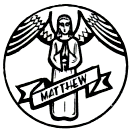 Winged Man |
 Winged Ox |
 Eagle |
||||||||||||
| Author | |||||||||||||||
Anonymous |
Anonymous |
Anonymous |
Anonymous |
||||||||||||
| Author, tradition | |||||||||||||||
| Mark the Evangelist According to tradition and early church fathers, the author is Mark the Evangelist, companion of the apostle Peter. |
Matthew the Tax Collector According to tradition, the Gospel of Matthew was written in "Hebrew" (Aramaic, the language of Judea) by Matthew, the tax-collector and disciple of Jesus. |
Luke the Evangelist According to tradition the Luke's author was Luke the Evangelist, companion of Paul. |
John, Son of Zebedee According to John 21:24, the author of John was "the beloved disciple". Later, this verse was attributed to John, son of Zebedee, a disciple of Jesus. |
||||||||||||
| Roman Author Mark is probably written by an unknown Roman Christian convert who was unfamiliar with Jewish customs. Contradiction However, Mark appears to contradict and oppose the view the gospel was based on Peter's preaching. |
Anonymous Author The Gospel of Matthew is anonymous: the author is not named within the text, and the superscription "according to Matthew" was added some time in the 2nd century Harrington1991 p.8 Nolland 2005, p.16 Educated Author Matthew is probably written by an unknown highly literate Greek speaking Christian Tribute It is claimed the Gospel was named 'Matthew', in tribute to the disciple Matthew (the tax collector). |
Greek Author Luke is probably written by an anonymous Christian author, who neither states his name or explicitly claims to be an eyewitness to any recorded events. He is likely to be an "amateur Hellenistic historian" versed in Greek rhetoric (standard training for historians). Marcion's Luke Luke existed in an anonymous single-book form in 140 AD when it was used by Marcion. Pagan God 'Lykos' It is speculated that Luke was based on and derived from an old Roman pagan story about the healing God, 'Lykos'. |
Disputed Author John's authorship is the most disputed, and is least trustworthy of all the Gospels. Fake Chapter However, most scholars today agree that John 21 is a later addition [false insert] into John's Gospel, which originally ended at John 20:31. Biblegateway |
||||||||||||
| Eyewitness Claim | |||||||||||||||
No |
No/Yes |
No |
No/Yes |
||||||||||||
|
Eyewitness testimony is a vital, central evidence to confirm the authenticity of the Bible and establish a real connection with Early Christianity.
Definition of Eyewitness: 1. EY'E-WITNESS, One who sees a thing done; one who has ocular view of any thing. King James Bible Dictionary/eyewitnesses 2. GREEK: αὐτόπτης, ἀυτοπτου, ὁ (αὐτός, ὈΠΤΩ), seeing with one's own eyes, an eye-witness Thayers Greek Lexicon/Eyewitness 3. EYEWITNESSES in Greek is autoptai (plural of autopt?s). However, in Luke's preface a historiographical one (history writing). It means those who are first hand observers. Bible.org/eyewitness |
|||||||||||||||
| Not Eyewitness According to tradition, Mark is not identified as an eyewitness. |
According to tradition, Matthew is identified as an eyewitness. Not Eyewitness The majority of modern scholars today hold Matthew and Luke were not eyewitness'. O' Day 1998, p.381 Reddish 2011, p.13 |
Not Eyewitness According to tradition, Luke is not identified as an eyewitness. In the preface, the author explains the process by which he prepared himself to write Luke. This implies he was not an eyewitness to events narrated. As the testimony is 'handed down to us' and so we have to undertake a 'careful investigation'. |
According to tradition, John is identified as an eyewitness.
Not Eyewitness The majority of modern scholars today hold Matthew and Luke were not eyewitness'. O' Day 1998, p.381 Reddish 2011, p.13 Too Late John was written too late to be the memóires of an eyewitness. Assuming, John was a young man present at Jesus' Crucifixion (in John 21:24). He would have been aged over 100 years when he authored the Gospel of John. The average life expectancy was 35 years. |
||||||||||||
| Divine Inspiration Claim | |||||||||||||||
No |
No/Yes |
No |
No/Yes |
||||||||||||
| The author of Mark did not claim divine inspiration in his writings. | The author of Matthew did not claim divine inspiration in his writings. Tradition, later upheld that as an eyewitness (disputed), Matthew was inspired by the Holy Spirit. |
The author of Luke did not claim divine inspiration in his writings. | The author of John did not claim divine inspiration in his writings. Tradition, later upheld that as an eyewitness (disputed), John was inspired by the Holy Spirit. |
||||||||||||
| Language | |||||||||||||||
| Jesus spoke: Aramaic/Hebrew Gospel text: Written in Greek |
Jesus spoke: Aramaic/Hebrew Gospel text: Written in Greek/Hebrew |
Jesus spoke: Aramaic/Hebrew Gospel text: Written in Greek |
Jesus spoke: Aramaic/Hebrew Gospel text: Written in Greek |
||||||||||||
| Jesus spoke Aramaic/Hebrew. The New Testament is written in eloquent Greek and not in the native tongues of anyone who met or followed Jesus. It is highly unlikely that Palestinian Jews (i.e. Jesus' disciples) wrote the Gospels.
Jesus almost certainly could not speak Greek Greek was spoken in the two major cities of Galilee (Sepphoris or Tiberius) among the cultured elite. Jesus was not from a major city or a member of the cultured elite. There is no evidence to indicate he ever travelled to the cities of Galilee, let alone that he was educated or cultured there. In Nazareth, Jesus would have had no reason to learn Greek, and probably had no way to learn Greek. There is no reference to him ever speaking Greek, or knowing Greek. Rural Galilee was completely Jewish (culturally) and thoroughly Aramaic (linguistically). Jesus was a rural Jew in the Jewish hinterlands of Galilee. He almost certainly could not speak Greek. Jesus' customers, if he was a carpenter, stone mason or a blacksmith would have been rural Jews like himself, who spoke Aramaic, not Greek speaking urbanites. Bart Ehrman, 2012 |
|||||||||||||||
| Narrative (Writing Style) | |||||||||||||||
| 3rd person | 3rd person | 3rd person | 3rd person | ||||||||||||
| 1st person narrative ("One day, when Jesus and I went into Capernaum...") 3rd person narrative ("One day, Jesus went to Campernaum and...") Narrative Proves Non-Eyewitness Testimony A 3rd person narrative is further evidence the authors were not eyewitnesses. Their narrative is based on what others have conveyed and informed them of. The question is who witnessed the actual event and can they be trusted? |
|||||||||||||||
| Geographical Location | |||||||||||||||
| Rome | Palestine | Achaia, Greece | Ephesus, Turkey | ||||||||||||
| Mark was written in Rome for a non-Jewish Christian community. |
Matthew was written in or near Palestine, where many Jews lived. Matthew himself was an ethnic Jewish male scribe from a Hellenised city, possibly Antioch, Syria. |
Luke was composed in the regions around Achaia, Southern Greece. Paul worked in Achaia, and Luke was an associate of Paul. |
John was written in Ephesus, Turkey given the Greek philosophical categories and spiritual bias. | ||||||||||||
| Gospel Naming | |||||||||||||||
| 'Mark' First Used 180-185 AD |
'Matthew' First Used 150 AD |
'Luke' First Used 180-185 AD |
'John' First Used 180-185 AD |
||||||||||||
|
Who First Referenced The Gospels?
Irenaeus (130-202 AD) goes on to argue that these four gospels and no others belong in a Christian canon. He is talking about our four Gospels, so they must have existed and even been collected by his time, in the late second century C.E.
Incredible Shrinking Son of Man: How Reliable Is the Gospel Tradition?. Robert M. Price 2003 Why Are Gospels Named Matthew, Mark, Luke and John?
Because sometime in the second century, when proto-orthodox Christians recognized the need for apostolic authorities, they 'attributed' these books
to
apostles (Matthew and John) and
close companions of apostles (Mark, the secretary of Peter; and Luke, the travelling companion of Paul).
Most scholars today have abandoned these identifications, and recognize that the books were written by otherwise unknown, but relatively well-educated Greek-speaking and writing Christians during the second half of the first century." Lost Christianities. Bart Ehrman 2003 What Were The Gospels Called Before? Justin Martyr (150-160 AD) quotes verses from the Gospels, but does not indicate what the Gospels were named. For Justin, these books are simply known, collectively, as the 'Memoires of the Apostles.' It was about a century after the Gospels had been originally put in circulation, they were definitively named Matthew, Mark, Luke, and John. This comes, for the first time, in the writings of the church father and heresiologist Irenaeus, around 180-185 AD." Forged. Bart Ehrman 2011 |
|||||||||||||||
| Writing For (Audience) | |||||||||||||||
| Non-Jews | Jews | Theophilus | Ephesians | ||||||||||||
| Mark was written for a non-Jewish community. Jewish Customs Aramaic phrases are interpreted and Jewish customs are explained for the audience. Ignorant of Judaism Mark is unfamiliar with Jewish ways of life. He misquotes the 10 Commandments, attributing God's words to Moses, and having Jews buy things on the Sabbath. Mark has Jesus quote a Greek mistranslation of the Old Testament. Some details such as what Jesus' personal prayers are made-up. Existing Stories The author uses existing stories (both Hebrew and Greek) and re-writes them with Jesus at the centre of the story, inplace of the original characters. Also, he was using passed-on stories with varied details, resulting in internal contradiction and inconsistency. |
Matthew was written for Jews who were aware of Jewish customs and practise.
Corrections Matthew corrected many of Mark's errors on Jewish life and added additional material. Old Testament Cited The author explicitly cites Old Testament messianic prophecies as having been fulfilled by Jesus. Fulfillment Nature The author is concerned with presenting the fulfillment nature of Jesus' ministry. |
Luke was written for a specific person, Theophilus, who may have paid the expenses incurred in writing the Gospel.
Corrections Luke corrected many of Mark's errors on Jewish life and added additional material. Roman Officer One theory is that Theophilus was a Roman officer or high-ranking official in the Roman government Theophilus-Luke-Acts |
John was written for local Ephesians, churches in Asia Minor and the surrounding community where the author lived.
Anti-Jewish John has many anti-Jewish views. It is totally different to the Synoptics. Anti-Judaism Fiction John is considered imaginative fiction or spiritual encouragement, but not authoritive or factual. |
||||||||||||
| Conclusion | |||||||||||||||
|
|||||||||||||||
CREDIT
http://www.humanreligions.info/gospels.html
http://slideplayer.com/slide/7619822/
Bart Ehrman (2011) p225
The Gospel According to Saint Mark. Vexen Crabtree 2006
Freke & Gandy (1999) p176.
| 22911 views · 13 hrs ago | Author: Guest • Updated: 12 May 2019 |
ALL ARTICLES ARE INTENDED FOR GENERAL EDUCATIONAL PURPOSES ONLY. ALL INFORMATION IS BELIEVED TO BE CORRECT, ACCURATE AND TRUTHFUL. YOU ARE ADVISED TO DO YOUR OWN RESEARCH. ARTICLES ARE LIVE DOCUMENTS AND MAY BE UPDATED WITH NEW CONTENT AT ANY TIME. WHERE AVAILABLE, SOURCES AND REFERENCES ARE CREDITED. IF YOU SPOT ANY ERRORS, OMISSIONS OR GIVE FEEDBACK KINDLY CONTACT US WITH DETAILS
111-bible-authorship
Videos on 'Bible Authors' (4)
 19:23
19:23
327 views · 4 days ago
327
1493856000
1781108214
On the Bible Authors - Bart Ehrman
001163
1
 2:01:23
517 views · 1 day ago
517
1493856000
1781324129
Bible Authors are not who we think they are #Forged - Bart Ehrman
007283
2
 9:04
9:04
671 views · 1 day ago
671
1535373031
1781336475
Documentary Hypothesis (JEDP Theory/Wellhausen): Evidence of multiple Old Testament Bible authors & writers - Blake Campbell
000544
3
 15:45
15:45
342 views · 5 hrs ago
342
1554229255
1781432229
Were Jewish Bible authors Polytheists for writing of many Gods? - Michael Heiser
000945
4
News on 'Gospel'
Exploring the Gap Between When the Gospels Were Written and the Oldest Copies We Have
| Patheos
23 Aug 2016 |
1677 views ·
3 days ago
1,700-year-old manuscript from 'Gospel of John' discovered on eBay for $99
| RT News
23 Nov 2015 |
1985 views ·
12 hrs ago
Questions for Christians waving Rainbow flags
| Gospel Coalition
01 Jul 2015 |
1892 views ·
9 hrs ago
'Lost gospel' claims Jesus and Mary Magdalene were married and had children
| Telegraph
12 Nov 2014 |
1998 views ·
5 days ago